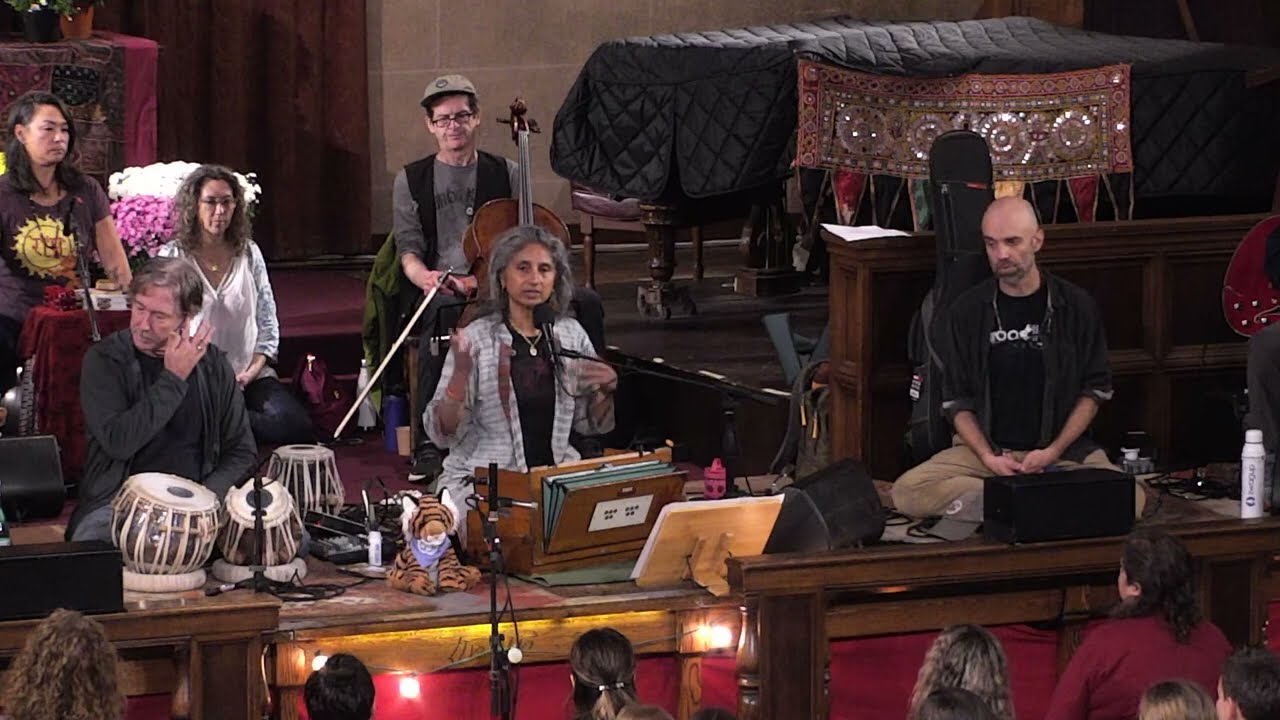
"Espíritu" is a kirtan composition by Ajeet that weaves together the Sanskrit devotional singing tradition with Spanish language and contemporary musical production, exploring the concept of spirit through sound and mantra. Released in 2018 on the album Indigo Sea, the piece represents an approach to kirtan that transcends linguistic and cultural boundaries while maintaining the transformative power of chant-based practice.
What is Espíritu in the context of kirtan music?
"Espíritu" (Spirit) is a musical composition by Ajeet that sits at the intersection of multiple devotional traditions. Kirtan itself is a Sanskrit-rooted call-and-response chanting practice, traditionally used in Hindu and yogic contexts to invoke presence, clarity, and connection to the divine. Ajeet's approach expands this framework by incorporating Spanish-language elements alongside Sanskrit mantras and English lyrics, creating a multilingual devotional experience. The piece appears on the 2018 album Indigo Sea, produced by Siobhán Moore, and has garnered over 336,000 views, indicating significant reach beyond traditional Sanskrit-speaking communities.
The composition reflects a broader movement within contemporary kirtan and mantra music toward inclusivity and cultural bridge-building. Rather than adhering strictly to Sanskrit or English, the inclusion of Spanish—a language spoken by over 500 million people globally—makes the devotional practice accessible to communities for whom neither Sanskrit nor English may be the primary spiritual language. This multilingual approach honors both the roots of the practice and the lived reality of contemporary spiritual seekers.
How does kirtan function as a spiritual practice?
Kirtan operates on the principle that sound itself carries transformative power. The call-and-response structure—where a leader sings or chants a phrase and participants echo it back—creates a feedback loop of vocal and emotional engagement. This format serves multiple functions simultaneously:
- Neurological effect: The repetition of mantras and melodies engages both hemispheres of the brain, potentially inducing states of coherence or meditative awareness even in participants without prior meditation experience.
- Community resonance: The collective nature of call-and-response singing creates a sense of unity and shared intention, dissolving individual isolation into group consciousness.
- Mantra activation: In Sanskrit-based kirtan, the specific phonetic qualities of mantras are believed to activate subtle energy centers (chakras) and attune the nervous system to higher frequencies of awareness.
- Emotional release: The act of singing, particularly in group settings, allows practitioners to externalize and process emotion in a contained, supportive environment.
Kirtan differs from meditation in that it is active, devotional, and participatory. Where meditation often emphasizes silence and internal focus, kirtan emphasizes sound, call-and-response, and communal presence. This makes it accessible to people who struggle with sitting in silence or who benefit from structured, rhythmic engagement.
Why include Spanish language in devotional music?
The incorporation of Spanish into kirtan and mantra music reflects a recognition that spiritual experience is not linguistically bound. Sanskrit has been the traditional language of Hindu and yogic devotional music for millennia, and it carries profound historical and energetic significance. However, the meaning and power of devotional practice ultimately rests not in the language itself but in the intention, presence, and surrender of the practitioner.
Spanish, as a Romance language with its own poetic and spiritual heritage, brings a different tonal and emotional quality to devotional music. The softer consonants and vowel-rich structure of Spanish create different resonances in the vocal cords and nervous system than Sanskrit or English. For Spanish-speaking practitioners—whether in Latin America, Spain, or Spanish-speaking communities globally—hearing mantras and devotional material in their native language removes a barrier to emotional accessibility. It allows the mind to relax into meaning rather than struggling to grasp unfamiliar sounds.
This approach also honors the indigenous spiritual traditions of Spanish-speaking regions, many of which have their own long histories of chanting, ceremony, and devotional practice. By creating bridges between Sanskrit kirtan and Spanish-language devotional music, artists like Ajeet acknowledge that the impulse toward spiritual connection through sound is universal, even as the specific languages and musical forms vary.
What role does production quality play in modern kirtan?
Traditional kirtan is often performed live, in acoustic settings, with minimal instrumentation—perhaps just drums, harmonium, or call-and-response vocals. The 2018 version of "Espíritu" on the album Indigo Sea, produced by Siobhán Moore, represents a contemporary approach where studio production, instrumental arrangement, and sound design become active participants in the devotional experience rather than afterthoughts.
Modern production in kirtan serves several purposes:
- Accessibility: High-quality recording and digital distribution make kirtan available to people who cannot attend live events or may not have access to traditional teachers or communities.
- Sonic depth: Layered instrumentation, harmonic support, and careful mixing can deepen the meditative and emotional impact of the chant. The "Indigo Sea" concept itself—suggested by the album title—points to a production aesthetic that evokes depth, vastness, and immersion.
- Cross-cultural fusion: Contemporary production techniques allow for the blending of instruments and styles from different traditions (e.g., Western instruments alongside traditional Indian instruments, electronic elements alongside acoustic ones).
- Repeatability: A studio recording can be returned to again and again, allowing a single listener to deepen their relationship with the practice over time, creating a personal practice rather than relying on live events.
The quality of production on "Espíritu" suggests that devotional music in the 21st century need not choose between authenticity and contemporary accessibility. Instead, thoughtful production can honor the roots of kirtan while making it relevant and engaging to new audiences.
How does spirit (espíritu) manifest in music and sound?
The title "Espíritu" points to a fundamental belief across many spiritual traditions: that spirit is not separate from matter or sound, but is accessible through sensory engagement, particularly through the voice and ear. In Christian mysticism, the concept of the Logos—the Word made flesh—suggests that divine principle expresses itself through sound. In Hindu philosophy, Nada Brahma (the universe is sound) posits that all existence arises from vibration. In Sufi tradition, qawwali music is explicitly understood as a path to divine union through sound and poetry.
When Ajeet releases a piece titled "Espíritu," the implication is that this particular arrangement of sound, rhythm, and intention is a vehicle for encountering something beyond the mundane self. This is not mysticism in the sense of irrationality, but rather an acknowledgment that sound affects us at levels below conscious thought. The vagus nerve, which plays a crucial role in regulating the nervous system, is directly stimulated by vocalization and by listening to harmonic, rhythmic sounds. The experience of singing or listening to devotional music creates actual neurological shifts that practitioners often interpret as spiritual experiences.
From this perspective, "Espíritu" is both literal and metaphorical: it is a song that contains and conveys spirit through the medium of sound, but the "spirit" encountered is also the spirit that emerges when individual consciousness is synchronized with collective presence, rhythm, and intention.
Where to go from here
If "Espíritu" resonates with you, consider exploring kirtan practice more deeply. This might mean attending live kirtan sessions in your community (many yoga studios, temples, and meditation centers host them), seeking out recordings from established kirtan singers like Krishna Das, Jai Uttal, or Snatam Kaur, or experimenting with singing mantras on your own. The practice requires no prior musical experience or knowledge of Sanskrit—only a willingness to sing, listen, and be present.
You might also explore the specific mantras or devotional concepts referenced in the piece, or research the production and musical arrangement to understand how contemporary tools can serve ancient practices. If you speak Spanish, consider how hearing devotional material in your native language shifts your experience compared to Sanskrit or English. Finally, consider the role of sound in your own spiritual life: whether through kirtan, singing, chanting, or simply deepening your attention to the sonic environment around you.